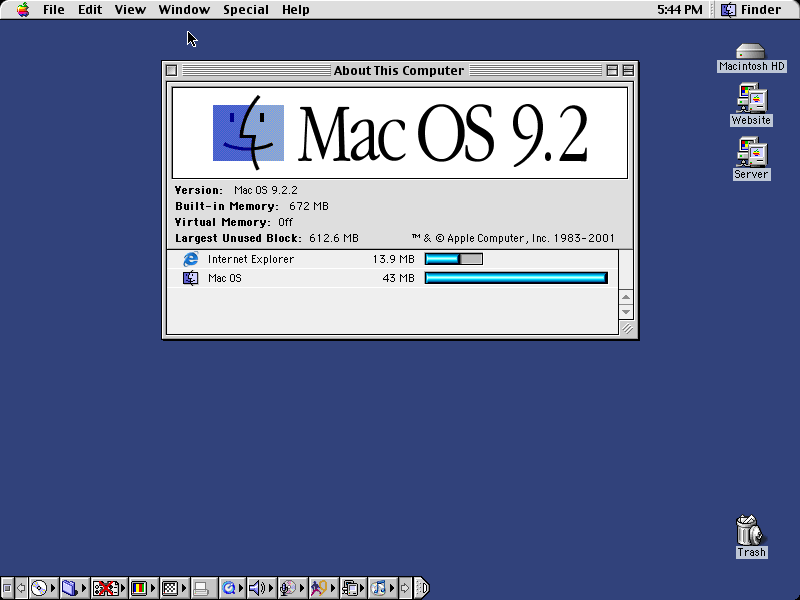
Powerpc Mac Os 9 Emulator
Darek's Secrets - NO EXECUTE! - Mac OS 8 Installation Guide |
Windows runs Mac OS.. and likes it!
Cross-platform compatibility between Mac and Windows is not a new concept. Since 1984, Macintosh and PC users have grappled with the problems of reading each other's disks, loading each other's files, and running each other's applications.
Utilities do exist to read Macintosh files on the PC. We even provide such a free utility to read Mac disks on a PC, which is handy for reading a Mac formatted disk that contains a common file such as a Word document, Excel spreadsheet, Photoshop document, or a GIF or JPG or HTML file.
Best software and games for OS 9/OS X PowerPC G3? So I decided that since I had one when I was a kid (and I'm a huge fan of nostalgia) I would get a iMac G3 from eBay. I managed to score a pretty respectable bargain on a machine (a lovely Indigo slot-loading model from 2000) and I came here to ask if anyone knows. About PearPC, a PPC Mac emulator for Windows and Linux, and to a limited extent MacOSX, that. For Windows, MacOSX, and Linux that can run System 7.5.3 through MacOS 9.0.4. 215, 4159 Mon May 11, 2020 9:00 am.
Some popular commercial utilities even go so far as to convert the file format for you, say from Mac Word 5.1 format to Word 2000 format. But the act of conversion may destroy the font information and change the document layout. This type of utility is a bad idea if you plan to 'round trip' the document back to a real Macintosh. It is a one-way operation at best.
Other tools, costing up to hundreds of dollars, do exist to allow Mac and PC computers to network together. But they do not solve the 'round trip' problem of moving a Mac file from a Mac application to a Windows application and then back to the Mac application.
None of these simple file copy utilities are really a good solution for the problems faced by real world Macintosh and Windows users:
The round trip problem - Create a file on a Macintosh. Copy it to a PC and edit it in Windows. Then copy it back to a Macintosh and editing it using the original application. Each time the file may lose font, formatting, and layout information and may require tedious editing to fix to get it back to the way it was originally.
The non-standard file format problem - Some file formats simply can't be converted from Mac to PC. The Mac applications that created the document do not exist for the PC, or the Windows version of the application lacks the ability to do the conversion.
The custom written software problem - Many schools have invested thousands of dollars and years of time in developing customized educational software. Artlandia symmetryworks serial macbook. While it may be inexpensive to replace the old Macintosh computers with PCs, it is not a trivial matter to rewrite millions of lines of computer code or to purchase thousands of dollars of new software which may not be able to read the old files.
The look-and-feel problem - While many Macintosh applications do have Windows equivalents, most Macintosh users prefer the look and feel of the Mac OS and the way that the applications look and behave on a Mac. What Mac Word user really wants to use Word 2000 or Word XP?
We have a better solution. If you love your Macintosh software and would prefer to use Macintosh applications over Windows applications, but you either have to use a PC or can't resist the low cost of PCs, why not simply use the PC to run the Macintosh software? What a simple idea!
Our solution, since we developed it in 1997, is to turn a PC into a Macintosh clone, and to run Mac OS and Macintosh applications directly on the PC. You benefit from the lower cost and faster speed of the PC, and still keep the use of your legacy Macintosh applications.
Not only does this provide you the easy ability to copy files back and forth between Mac and PC, but it solves the round trip problem, it solves the non-standard file format problem, it solves the custom written software problem, and it solves the look-and-feel problem. Because with emulation, you don't stop using your original Macintosh software and you are not required to purchase additional Windows applications. All you need is a PC, one of our emulators, and the Mac software that you already have.
Using aMacintosh emulator, your PC can:
Run the Mac OS on x86 processors - run Mac OS on Intel and AMD processors, and run Mac OS and Windows at the same time.
Read Macintosh disks - read your Macintosh floppy disks, CD-ROMs, Iomega ZIP disks and other Mac disks directly.
Run most Macintosh programs - our current emulators run about 90% of all System 6, System 7, and Mac OS 8 compatible Macintosh software.
Have faster speed and larger memory - run Macintosh applications at close to the full clock speed of your PC with up to a gigabyte of memory.
Our products have been seen on television's Digital Desk show, in Japan's Mac Power magazine, at Macworld Expo San Francisco, Macworld Expo Tokyo, CeBIT Hannover, COMDEX Las Vegas, and numerous other computer shows around the world.
Emulation is a great way for a PC to be more Mac friendly in a mixed Mac/PC environment. And it is a great way to replace an older Macintosh computer with a fast inexpensive PC while retaining backward compatibility with the older machine's software.
SOFTMAC - The intelligent solution to Macintosh - Windows compatibility
A solution for every PC and every budget. Whether your PC is running MS-DOS, Windows 95, or Windows XP, we offer a variety of Mac emulation tools, utilities, and software bundles to help you read and run Mac files on your PC. You may download our tools free of charge for home and personal use.
SoftMac XP Classic Edition, or simply SoftMac Classic, is the free Macintosh emulator for Windows, featuring 68000, 68030, and 68040 emulation in a single emulator and support for emulating Mac Classic, Mac II, and Mac Quadra computers. It supports all versions of Mac OS from the original 1.1g through System 6, System 7, Mac OS 7.5 and 7.6, and Mac OS 8.0 and 8.1. For use with Windows 95, Windows 98, Windows 2000, Windows NT 4, Windows Me, and of course, Windows XP.
SoftMac XP Xpress Edition, or simply SoftMac Xpress, is our most optimized Macintosh emulator, delivering 30% to 100% more speed than past releases of SoftMac when used with Windows XP on an Intel Pentium 4 processor, and featuring two-way drag-and-drop file copy support between Mac and PC disk volumes.
Download SoftMac XP - get both Classic Edition and Xpress Edition right now!
SoftMac Online Documentation - instructions for installing SoftMac. Print and read carefully!
SoftMac Online Tutorial - shows you how to install Mac OS 8 and Macintosh applications. Print and read carefully!
All releases of SoftMac will boot Mac OS 8.1 in under 15 seconds on a typical Windows PC. By being able to emulate different types of Macintosh computers, SoftMac supports both '32-bit clean' and '32-bit dirty' Macintosh applications, and runs all 68K compatible versions of Mac OS (including System 7, System 6, and earlier) up to and including Mac OS 8.1.
The PowerPC processor is not emulated at this time by current releases of SoftMac, so Mac OS 8.5, 8.6, 9.0 and X are not supported since those versions of Mac OS require the PowerPC processor. PowerPC native applications are also not supported at this time.
A PC running MS-DOS cannot run SoftMac since SoftMac is designed for use on Windows only. For MS-DOS users we offer a free product called Fusion PC 3.0. It features fast 68040 emulation with an extremely small disk footprint. It is recommended for use on older 486 and Pentium systems running MS-DOS, or Windows 95/98 MS-DOS Prompt windows. Fusion PC 3.0 runs System 7.0 and 7.1, as well as Mac OS version 7.5, 7.6, 8.0, and 8.1.
Download Fusion PC 3.0 - setup files and documentation
All of our emulators run Mac software very quickly, typically delivering 50% to 70% of the clock speed in emulation. In other words, a 500 MHz PC running Windows 98 can emulate the equivalent of a 300 MHz Macintosh Quadra running Mac OS 8. Your results will vary depending on the exact type of PC you are using, the amount of RAM present, the version of Windows being used, video drivers, etc. For a good explanation on exactly what type of PC to use and how fast your results can be, see our Hardware Requirements and Benchmarks page.
IMPORTANT: All versions of SoftMac and Fusion PC require that you provide a valid Macintosh ROM BIOS (which all Macintosh computers use to start booting) and a valid Mac OS startup disk. Without these two items, and emulator will not boot or work, just as a real Macintosh computer cannot work without these items. You should download the free SoftMac XP or Fusion PC release to verify that you have the necessary ROM BIOS and Mac OS before purchasing a more advanced SoftMac release.
All users of Mac emulators fall into one of 3 categories. You should determine exactly which of the 3 categories applies to you, and this will determine whether you need to purchase a ROM card and/or ROMs, or whether you can use SoftMac entirely without any additional hardware. The 3 categories are:
You do not currently own a Macintosh computer of any kind. You will have to purchase our ROM card and a set of Macintosh ROMs and use that hardware inside your PC. You will likely also need to purchase Mac OS and other Macintosh software.
You do own a Macintosh computer, but one that is not functioning. You will need to purchase our ROM card and you will have the option to then install your computer's ROMs into the ROM card. In effect, transferring the functionality of your Macintosh computer into your PC. Only specific Macintosh ROMs are supported by the ROM card, so please consult our Macintosh ROM Chart to verify that you have the correct ROMs.
You do own a Macintosh computer that is functioning. You may be able to simply create a ROM image of your Macintosh's BIOS by running a small utility on your Macintosh. Again, please consult the Macintosh ROM Chart to verify that your ROMs are supported as ROM images. SoftMac currently supports over 30 different Macintosh ROM BIOS versions that are used in dozens of different models of Macintosh computers and we are adding support for new BIOS versions every month.
On April 20 2002 we released the SoftMac XP version 8.20 Suite CD-ROM. This latest release improves Windows XP support and Windows XP optimizations which deliver up to 100% faster speed than previous SoftMac 2000 releases. Two Windows XP compatible releases of SoftMac are included - SoftMac Classic which minimizes memory usage and is better suited for older Windows 95 based PCs, and SoftMac Xpress which delivers faster speed and is optimized for Pentium 4 and Athlon processors. Both version include a more intuitive user interface over SoftMac 2000.
The SoftMac XP Suite comes with some additional software, including the Fusion PC 3.0 Apple Macintosh emulator for MS-DOS, the Gemulator Atari ST emulator for Windows, and easier to use file copy utilities which simply copying files between Mac and PC disk volumes. We also offer additional third party Macintosh software such as Mac OS 8 and Claris Works, shareware software for the Mac, as well as Macintosh ROMs for use with SoftMac XP and other Macintosh emulators.
Attention! At this time (the year 2008) the SoftMac XP Suite is no longer sold online or through dealers. However, we are liquidating our unsold inventory of SoftMac CDs, unopened Mac OS 8 packages (Mac setup CD-ROM and/or Mac floppy disks), the shareware CD, and other items. .
Some quick facts about the latest SoftMac XP release:
supports Windows XP, Windows 2000, Windows Me, Windows 98, Windows NT 4.0, and Windows 95
compatible with all 486, Pentium, Celeron, AMD K6, Duron, and Athlon processors
30% to 100% faster performance than previous SoftMac 2000 releases
emulates 68000, 68010, 68020, 68030, and 68040 processors
emulates 68881/68882/68040 floating point co-processors
emulates Mac Classic, Macintosh II, Macintosh LC, and Macintosh Quadra computers
runs System 6, System 7, and Mac OS 8, including Mac OS 8.1 and Mac OS 7.6
support for emulating 1 gigabyte (1024 megabytes) of Macintosh memory using an efficient swap file
multiple CD-ROM and DVD-ROM support - mount up to 9 CD-ROM devices at once
direct reading of Apple Macintosh floppy disks, CD-ROMs, hard drives, LS-120 and Iomega ZIP disks
disk image support allows mounting of SCSI hard disk and CD-ROM disk image files
easy drag-and-drop file copy support between Mac and PC disks
high resolution graphics supporting up to 1900x1080 color modes
support for editing and switching between 16 custom configurations
'Hibernate' command - quickly saves Macintosh session to hard disk
built-in links to useful web sites and online help
As with most emulators and as explained above, SoftMac requires the ROM BIOS from a Macintosh computer in order to properly work. This is both a legal and technical requirement. If you own a functioning 68K based Macintosh computer, you can run a ROM dumping utility (which we supply) on your Macintosh and save its ROM BIOS to a disk file. That ROM file can then be copied to your PC and used with SoftMac and in many cases also used with our Fusion PC 3.0 emulator. The directions for doing this, as well as the ROM dump utility itself are on our SoftMac Online Documentation page. Please check the ROM chart below to make sure you have the necessary model of Macintosh to create the ROM image with. If your ROMs are listed as supported, congratulations, you can skip the rest of this page!
If you do not have a working Macintosh computer or do not have the necessary model of Macintosh computer, you must use ROM card and plug in real Macintosh ROMs into the card which then plugs into your PC. The ROM card which we manufacture has 8 ROM sockets which allows you to plug in two or more sets of Macintosh ROMs at once. This gives you the ability to run SoftMac and emulate multiple Macintosh computers at the same time, each running from a different ROM on the ROM card.
If you purchase our ROM card, you have the option to have us pre-install a set of Mac OS 8 compatible Macintosh ROMs on the card. If you wish to save some money and purchase just the ROM card without pre-installed ROMs, or you are an existing customer with a ROM card already installed, you can add your own Macintosh ROMs to the ROM card. You have several ROMs to choose from depending on what kind of Macintosh you wish to emulate and the kind of Macintosh software you wish to run:
For running older 68000 software (typically old Macintosh Plus or Macintosh SE software) you will want to use 128K Macintosh Plus ROMs. These can run System 6, System 7, and System 7.5.5, and do support reading high density 1.44M floppy disks and other Macintosh disks. These ROMs easily plug out of any Macintosh Plus computer because they are always socketed.
The first generation of color Macintosh ROMs are the original Macintosh II series (II, IIx, IIcx, and SE/30). These ROMs support color and are great for running System 7 and System 7.5. They are relatively inexpensive and can be plugged out of most Macintosh II computers because they are usually socketed (except in the IIcx). These ROMs however do not run Mac OS 8 because they are not 32-bit clean and support at most 8 megabytes of memory, limiting their usefulness.
The second generation of Macintosh II ROMs are the 512K, 1M, and 2M ROMs found in the Macintosh IIci, IIsi, LC series, Centris series, and Quadra series computers. These ROMs are 32-bit clean, meaning they support up to 1024 megabytes of Macintosh memory, they run System 7, 7.5, as well as Mac OS 7.6, 8.0, and 8.1, and are generally much faster and less buggy than the original Macintosh II ROMs. These are the ideal ROMs to run with SoftMac and are the type of ROMs that we install with our ROM cards.
The ROM card can accept almost all types of Macintosh ROMs manufactured between about 1984 and 1992, covering everything from the Mac 128 to the higher end Mac IIci and LC models. Although the card cannot physically accept 1M or larger ROMs due to the shape of those ROM chips, the 512K IIci and LC ROMs work just as well and do support Mac OS 8.
To extract the ROMs and install them on the card, first remove the cover from the Macintosh. Look for the ROMs on the motherboard. They will be a 1, 2, or 4 chip set in a 28-, 32-, or 40-pin package. Most Mac motherboards label the ROM chips right on the board with markings such as 'ROM HIGH', 'ROM LOW', 'ROM HH', 'ROM LL', etc.
On each ROM will be part number of the form 341-0XXX or 342-0XXX. The XXX is a 3 digit part number than uniquely identifies each ROM chip. For example, the picture here shows a set of Mac 512 ROMs plugged into the ROM card. If you can read it, note the part numbers on the two chips - the first one is 342-220-A, the second chip is 342-221-A.
Once you unplug the ROMs from the Macintosh, installing the chips is easy. Install the chips in numerically in the order listed in the chart below so that SoftMac will detect them correctly. When installing 28-pin chips, leave empty pins to the left of the chip as pictured above. ROM chips will 32 pins will plug in covering the entire socket. 40 pin ROMs (such as from the LC III) are not supported directly without using additional sockets to sit on top of our card and are not recommended. A ROM image of those ROMs can be used though.
The following is a list of ROMs and part numbers that we've cataloged so far. We will be updating this list as we test ROMs from more Mac models.
For each Macintosh ROM we list the models of computers that the ROM was used in and the unique 'checksum' of the ROM. The checksum is displayed by the ROM dump utility and identifies the specific version of the ROM. Apple released dozens of different Macintosh ROMs over the years. For each ROM we also list the type of processor that it supports, the size of the ROM image, the physical information about the ROM chips, the part number, the versions of Mac OS supported by the ROM, and which emulators support this ROM.
Information that is unknown or unsupported is marked with a * symbol.
ROMs that are marked as 'jumpers' are not standard 28- or 32-pin ROMs and will require extra installation steps. Installing them yourself is not recommended.
Emulators legend: G = Gemulator 2000, S = SoftMac 2000/Classic/Xpress, P = planned for a future SoftMac release, F = Fusion PC
| Macintosh Model or Series | Processors supported by ROM | Emulators which support this ROM | ROM size in kilobytes | ROM chips | Pins on each ROM chip | Part number 341-0XXX 342-0XXX | ROM checksum | Mac OS versions supported |
| Mac 128 Mac 512 | 68000 | G, S | 64 | 2 | 28 | 220, 221 | 28BA61CE 28BA4E50 | 1.1g to ??? |
| Mac Plus | 68000-68020 | G, S | 128 | 2 | 28 | 341, 342 | 4D1EEEE1 4D1EEAE1 4D1F8172 | 1.1g to 7.5.5 |
| Mac SE (800K) | 68000-68020 | S | 256 | 2 | 28 JUMPERS | 352, 353 | B2E362A8 | 1.1g to 7.5.5 |
| Mac SE (HDFD) | 68000-68020 | S | 256 | 2 | 28 JUMPERS | 701, 702 | B306E171 | 1.1g to 7.5.5 |
| Mac Classic | 68000-68020 | S | 256 or 512 | 1 | 40 JUMPERS | 813 | A49F9914 | 1.1g to 7.5.5 |
| Mac II (800K) | 68020-68030 | S | 256 | 4 | 28 | 105, 106, 107, 108 | 9779D2C4 97851DB6 | 5.0 to 7.5.5 |
| Mac II (HDFD) Mac IIx Mac IIcx Mac SE/30 | 68020-68030 | S | 256 | 4 | 28 | 639, 640, 641, 642 | 97221136 | 5.0 to 7.5.5 |
| Mac Classic II Mac IIvi | 68020-68040 | S, F | 512 | 4 | 32 | 864, 865, 866, 867 | 3193670E | 6.0.5 to 8.1 |
| Mac IIci | 68020-68040 | S, F | 512 | 4 | 32 | 736, 735, 734, 733 | 368CADFE | 6.0.5 to 8.1 |
| Mac IIsi | 68020-68040 | S, F | 512 | * | * | * | 36B7FB6C | 6.0.5 to 8.1 |
| Mac IIfx | 68020-68040 | S, F | 512 | * | * | * | 4147DD77 | 6.0.5 to 8.1 |
| Mac LC | 68020-68040 | S, F | 512 | 4 | 32 | 392, 393, 394, 395 | 350EACF0 | 6.0.5 to 8.1 |
| Mac Iici Mac LC II | 68020-68040 | S, F | 512 | 4 | 32 | 476, 475, 474, 473 | 35C28F5F | 6.0.5 to 8.1 |
| Mac IIxi | 68020-68030 | S, F | 512 | * | * | * | 35C28C8F | 6.0.5 to 8.1 |
| Mac Color Classic | 68020-68040 | S, F | 1024 | * | * | * | ECD99DC0 | 7.0.1 to 8.1 |
| Mac IIvx | 68020-68030 | S | 1024 | * | * | * | 49579803 | 5.0 to 7.5.5 |
| Mac LC III Performa 460 | 68020-68040 | S, F | 1024 | 2 | 40 JUMPERS | 661 662 | ECBBC41C | 7.0.1 to 8.1 |
| Powerbook 180 | 68020-68040 | S, F | 1024 | * | * | * | E33B2724 | 7.0.1 to 8.1 |
| Mac LC 475 Performa 475 Quadra 605 | 68020-68040 | S, F | 1024 | * | * | * | FF7439EE | 7.0.1 to 8.1 |
| Mac LC 580 Performa 580 | 68020-68040 | S, F | 1024 | * | * | * | 064DC91D | 7.0.1 to 8.1 |
| Mac LC 630 Performa 630 | 68020-68040 | S, F | 1024 | * | * | * | 06684214 | 7.0.1 to 8.1 |
| Centris 610 Quadra 610 | 68020-68040 | S, F | 1024 | * | * | * | F1A6F343 | 7.0.1 to 8.1 |
| Centris 650 Quadra 650 | 68020-68040 | S, F | 1024 | * | * | * | F1ACAD13 | 7.0.1 to 8.1 |
| Quadra 700 Quadra 900 | 68020-68040 | S, F | 1024 | * | * | * | 420DBFF3 | 7.0.1 to 8.1 |
| Quadra 950 | 68020-68040 | S, F | 1024 | * | * | * | 3DC27823 | 7.0.1 to 8.1 |
| Quadra 660AV Quadra 840AV | 68020-68040 | S | 2048 | * | * | * | 5BF10FD1 | 7.0.1 to 8.1 |
| Powerbook 5300 | 68040-PPC | P | 4096 | * | * | * | 63ABFD3F | 7.5 to 9.0 |
| Power Mac 6100 | 68040-PPC | P | 4096 | * | * | * | 9FEB69B3 | 7.5 to 9.0 |
| Power Mac 7100 | 68040-PPC | P | 4096 | * | * | * | 9A5DC01F | 7.5 to 9.0 |
| Power Mac 8600 | 68040-PPC | P | 4096 | * | * | * | 960E4BE9 | 7.5 to 9.0 |
| Power Mac G3 | 68040-PPC | P | 4096 | * | * | * | 79D68D63 | 7.5 to 9.0 |
| ??? | 68040-PPC | P | 4096 | * | * | * | 96CD923D | 7.5 to 9.0 |
If you have a Mac not listed here or have ROMs with different part numbers, let us know so we can add them to the list. Give us the model of Macintosh, the year it was manufactured, the type of processor inside of it, the number of ROM chips, the number of pins on each ROM, and read off all the text on each ROM.
Please do not send us information about old Macintosh clones (UMAX, Power Computing, etc.) or Mac OS X only machines. These are not true classic Macintosh computers and are thus not intended to be supported by our emulators.
Copyright © 1996-2015 Emulators, 14150 NE 20th Street, Suite 302, Bellevue, WA 98007, U.S.A.
Questions and comments can be sent to emulators@emulators.com.
Email is usually responded to within 2 to 3 business days.
Apple, Mac OS, Macbook, and Macintosh are registered trademarks of Apple Computer, Inc. Atari is a registered trademark of Atari U.S. Corporation. Athlon, Athlon XP, Opteron, and Phenom are registered trademarks of AMD. Microsoft, Windows, Windows NT, Windows XP, Windows Vista, Windows 7, Windows 8, Windows 10, Visual Studio, .NET, and/or other Microsoft products referenced herein are either trademarks or registered trademarks of Microsoft. Intel, Pentium, Core 2, Core i7, and Atom are registered trademarks of Intel. PowerPC is a trademark of IBM. Additional company and product names may be trademarks or registered trademarks of the individual companies and are respectfully acknowledged.
The SheepShaver Wrapper for OS X and macOS
Summary How to set it up Acknowledgments Support
An easy way to run 'classic' applications under OS X and macOS
OS X and macOS no longer makes it possible to run 'classic' Mac applications written for 'classic' Mac OS versions, such as System 7 or Mac OS 9. In order to run such applications, OS X and macOS users must now install 'emulator' software that runs old versions of the Mac OS in a window on the OS X or macOS desktop. The most advanced of these emulator programs is SheepShaver. SheepShaver is no longer supported by its original author, Gwenolé Beauchesne, but minor updates are available from an active support forum at E-Maculation.
This page provides a system that makes it easy to set up and use SheepShaver under OS X or macOS 10.8 or later. You will need to supply a 'ROM file' (as described below) and you will need an installation CD for any version of the Mac OS from OS 8.5 through 9.0.4, or a disk image of such a CD, as described below.
This system requires OS X or macOS 10.9 or later. It was updated on 8 March 2019 with an improved 64-bit version of SheepShaver that should run under macOS 10.14 Mojave, and on 18 August 2019 with a 4GB (not 2GB) disk image. It was updated 18 Octobef 2019 with a version that run smoothly under macOS 10.15 Catalina.
How to set it up
The usual way to set up SheepShaver is to follow the detailed guide on the E-maculation site. The page you are now reading provides a much simpler method, using a prebuilt 'application bundle' that contains almost everything you need, in a single package. To use it, follow these steps. Note that when the instructions refer to OS 9, the same procedure should work with OS 8.5 or 8.6. (Expert users will know how to modify the system for use with System 7 through 8.1; non-experts should not attempt this.)
1. Download the application bundle here. It is enclosed in a 13 MB ZIP file. Extract it and place it anywhere on your hard disk. Do not launch the application until you finish step 2; if you do, it will display a warning that you need to add a ROM file, and SheepShaver will not start.
2. Get a copy of a New World Mac PPC ROM. See the setup guide at E-Maculation for advice on how to find one. (Or you can go directly to the Redundant Robot web site and find the file indicated as 'best for SheepShaver'.) The ROM file that you find will probably be named something like 'newworldrom'; make certain to rename the ROM file Mac OS ROM (use this exact string; no extension) and drop the ROM file onto the SheepShaver Wrapper. A message from the SheepShaver Wrapper will tell you that the file was copied to the correct location.
3. Install Mac OS 8.5 through 9.0.4. This step assumes that you have a copy of an OS 8.5 through 9.0.4 installation CD on a disk image. (You cannot use an actual CD, only an image made from a CD.) The installation CD image must be one that was made from a retail CD, not one that came with a specific machine. Note that when installing, you should not try to format or initialize the virtual hard disk; it is already formatted, and contains some Apple-supplied updates for OS 8.6 and 9.0.4 in a disk image file in a folder named 'OS Updaters'. Some of these are US-English versions; other versions may be found through a web search.
Note: To create an image file from an installation CD, use Disk Utility in OS X or macOS and create a disk image in 'DVD/CD Master' format.
(Important note: When installing OS 9, when you reach the menu that lets you specify which parts of the OS you want to install, click Options and turn off the option to 'Update Apple Hard Disk Drivers'; for reasons that I don't understand, the OS installation may stall when this option is on. When booting from an OS 8.5 CD image, hold down the shift key to turn extensions off, or else the CD image may not boot; this is not required with OS 8.6.)
3. Drop your CD image file of a Mac OS installation CD on the SheepShaver Wrapper. If the file is in the correct format, and is bootable, SheepShaver will boot from the image file. (If the image file is not 'locked,' which it must be if the Mac OS is to be installed from it, the SheepShaver Wrapper will offer to lock it for you.) Install the Mac OS from the booted CD image. Then shut down SheepShaver completely. Start the SheepShaver Wrapper again, and it should now boot to OS 8 or 9, and the CD image will not be mounted.
4. Start up SheepShaver and start working in Mac OS 8 or 9. The steps above will give you a working SheepShaver system, with the 'Unix' folder in SheepShaver set to be your Documents folder in OS X or macOS. If you want to use a different folder as the 'Unix' folder, or if you want to change the screen size or other features, use the Preferences menu.
4. Study the configuration guide at E-Maculation. The Configuration Guide includes absolutely essential information about using the 'classic' Mac OS in SheepShaver. If something goes wrong, and you have not studied that guide, then you have only yourself to blame.
The virtual hard disk in the system is a 4GB disk. If that does not provide enough disk space for your purposes, create a second disk, using the procedures described in the wiki at Emaculation.com. Or use the SheepShaver Preferences to add the unformatted Backup 4GB disk also included in the system.
Acknowledgments
This system is built on software provided by many people who are more expert than I am. The included build of SheepShaver is slightly customized from code modified by the programmer who uses the name kanjitalk755. I have benefited from many suggestions by Ronald P. Regensburg and others in the E-Maculation forum, and I could not have written this script without the help of many experts at Macscripter.net and especially from Shane Stanley there at Macscripter.net and at the forum at latenightsw.com.
Support
Please do not ask me to help you set up the 'classic' Mac OS or advise you about any applications. Please ask for support in the E-Maculation support forum for SheepShaver. If you want to get in touch with me about the AppleScript in the SheepShaver Wrapper, then please visit this page.
Edward Mendelson (em thirty-six [at] columbia [dot] edu, but with two initials and two numerals before the [at] sign, not spelled out as shown here).