Nfts For Mac Usb Formatter
If you have ever tried to format a USB thumb drive or memory stick, you may have noticed that the only file system options you have are FAT and FAT32. This is the default behavior in Windows. However, with some slight tweaking of settings, you can actually format your removable storage devices in NTFS format, including external hard drives, etc.
Mar 20, 2020 Here are three proven methods on how to format USB flash drive to NTFS. 1.Find My Computer in the Start menu or by typing it in the Search bar. Right-click on it and click on Manage. 2.In Device Manager, look for your USB drive in Disk Drives tab. The second task is how to format NTFS drive on Mac. NTFS is built for windows operating system therefore it is not supported by Mac. For this case, it is advisable to install programs called NTFS 3G, which works in, handy with MacFuse. Both of these are first installed in the computer.
Of course, Windows defaults the formatting of removable storage to FAT and FAT32 for certain reasons. There are actually a few advantages and disadvantages to formatting a USB drive in NTFS format, so we’ll go through those before actually talking about how to do it.
The advantages of enabling NTFS on removable storage devices are fairly enticing. For example, an NTFS file system lets you add Allow and Deny permissions to individual files and folders for specific Windows users, something you cannot do in the FAT file system. In terms of security, you can also encrypt files using the built-in encryption in Windows.
Another major benefit of switching to NTFS is that you are no longer restricted to storing files less than 4GB in size on the device. FAT32 can only work with files up to 4G in size and volumes up to 2TB in size. So if you want to format your 5 TB external hard drive as a single volume with FAT32, you wouldn’t be able to do it.
Files stored on FAT32 file systems also have a much higher chance of being corrupted as opposed to NTFS. NTFS is a journaling file system, which means that before an actual change is made to the data, it is first logged in a “journal” so that if something happens in the middle of writing data, the system can recover quickly and not need to be repaired.
Other benefits include the ability to compress files and therefore save space on your USB drive. You can also set disk quotas and even create partitions! So formatting USB drives with NTFS has several advantages that would be good if you need to use some of these advanced features, i.e. extra security or storing large files.
However, there are also a few drawbacks to using NFTS on a USB drive. Firstly, there is a lot more writes to the drive that are required when using NTFS and therefore access to the device will be slower. It will also reduce the life of your flash memory on USB drives because of the extra writes. Also, versions of Windows older than 2000 (except some versions of Windows NT) cannot read NTFS file systems, nor can most Linux systems until recently, so your compatibility goes down significantly. All other devices like cameras, smartphones, TVs, tablets, etc. will most likely only be able to read FAT32.
The other major downside is that if you encrypt your files on the USB drive or use any kind of file permissions, you will not be able to open them anywhere else. Actually, this can be considered a downside or an upside depending on what you want to do. If you want to secure your USB stick so that only your user account on your one computer can open the files, then using encryption or permissions is perfectly fine. If not, then do not add permissions or encrypt the files.
How to Format USB Drive with NTFS
If you are running Windows 7 or Windows 8, the process is really simple. First, go ahead and plug in your USB device and then open Computer from the desktop.
Just right-click on the USB device and choose Format.
Now open the File system drop down and choose NTFS. You don’t have to do anything else and the NTFS option should appear in the list.
In Windows Vista and XP, you may not see the NTFS option under File systemDeed plotting software for mac software. , in which case you have to tweak a setting first. First, connect your USB device to your computer and then right-click on My Computer from the desktop and choose Manage.
Next click on Device Manager and then expand out Disk Drives. You should see your USB drive listed there as “Generic USB 2.0 USB Drive” or something similar.
Now right-click on the USB drive under Disk Drives and choose Properties and then go to the Policies tab.
Now you will see two options, the Optimize for quick removal selected by default. Go ahead and change that by selecting the “Optimize for performance” option. This enables writing caching in Windows and therefore allows you to format it as NTFS! Sweet.
That’s about it. Before you start the format, you will need to eject the USB drive and then plug it back in. Now click OK, go to My Computer, right click on the USB drive and choose Format. In the File System drop down you should now see the option for NTFS!
Troubleshooting NTFS Formatting
If you run into an issue while formatting to NTFS, it will probably be an error message stating that Windows was unable to complete the format. The main reason this can occur is when it tries to delete the primary partition and for some reason fails.
In that case, you can just Disk Management to format the drive instead of using Explorer. Go ahead and right-click on My Computer or Computer, choose Manage and then click on Disk Management.
Now find the disk listed down at the bottom with the label Removable and make sure it’s the correct size. Right-click on the white area and choose Format. You’ll get a message that there is an active partition on the disk and that all data will be lost; go ahead and click Yes to continue. Now choose NTFS and perform the format.
You can now use the advanced features of NTFS of on your USB device to make it more secure, store larger files, etc. If you have any questions, post a comment. Enjoy!
Cross-platform incompatibility has been a huge roadblock for people who have to move back and forth between Windows and macOS, especially when you need to share files between Windows and Mac using an NTFS drive. After you connected an NTFS drive such as a Seagate or WD My Passport NTFS drive to the Mac, you found that you could view the files stored on your NTFS-formatted drive on Mac, but you couldn't edit, rename, copy, paste, delete, move or create files on it.
Any ways that you can read-write to NTFS drives on Mac running either macOS or Mac OS X? This article will introduce three solutions for you to solve the ready-only NTFS drives on Mac without formatting.
- Table of contents
- 1. Can macOS read NTFS drives?
- 2. How to read-write to Microsoft NTFS drives on Mac?
- 3. Conlusion
Can macOS read NTFS?

Yes, you can read Windows NTFS-formatted USB flash drives, SD cards, memory sticks and external hard drives without any problem.
No matter what Mac you are using, either a desktop or a laptop, and no matter which Mac operating system is running on your Mac, macOS or Mac OS X, you are able to read NTFS drives on Mac. You can view your files by opening them. Files will appear the same quality as they do on a PC. What's more, if you have used Boot Camp Assitant to create a Windows BootCamp partition on your Mac SSD, the BootCamp partition is also formatted with NTFS. Therefore, you have read support to Bootcamp partition on your Mac SSD as well.
However, your files will show read-only or locked beside the file name. You can't make any changes to those files nor create/save/move any files on the NTFS drives on Mac. Sharing files between NTFS drives and Mac looks impossible.
Want to have full read-write access to NTFS drives or BootCamp partition on Mac? Keep reading to learn how to enable NTFS write support on Mac and mount BootCamp partition with read-write support.
How to read-write to Microsoft NTFS drives on Mac?
In this section, three options are introduced:
- Free NTFS drivers for Mac
- Cost-effective NTFS for Mac software
- Apple's native NTFS support
Option 1: Free but complicated NTFS driver for Mac
There are some free NTFS drivers for Mac that can help you read-write to NTFS drives on Mac. For example, FUSE for macOS is an open-source project. It can mount NTFS drives in read-write mode.
The process will be very technical and please follow the guide very carefully.
Step 1: Download and install Xcode.
1. Go to Finder > Applications > Utilities > Terminal and run the following command line: xcode-select --install.
2. Click 'install' when you are asked to install the Apple's command line developer tools.
Step 2: Download and install Homebrew.
1. Go to the Terminal window and run the following command line:
/usr/bin/ruby -e '$(curl -fsSL https://raw.githubusercontent.com/Homebrew/install/master/install)'.
2. Hit Enter to install it (provide password when prompted).
Note: If you have installed Xcode and Homebrew before, messages will pop up in Terminal window telling you have installed them before. You just ignore the messages, keep doing the next steps.
Step 3: Download and install FUSE for macOS.
Use default options when installing it.
Step 4: Install NTFS-3G.
1. Go to Terminal window and run the following command line: brew install homebrew/fuse/ntfs-3g.
2. Hit Enter.
Step 5: Disable SIP (System Integrity Protection).
SIP exists to protect the operating system from unauthorized changes.
1. Restart your Mac and hold down Command + R immediately until you see the Apple logo.
2. Open Terminal from the Utilities menu.
3. Run the command line: csrutil disable.
4. Hit Enter.
5. Reboot the Mac.
Step 6: Read and write to NTFS on Mac.
1. Go to Finder > Applications > Utilities > Terminal.
2. Run the following command line:
sudo mv /sbin/mount_ntfs /sbin/mount_ntfs.original
sudo ln -s /usr/local/sbin/mount_ntfs /sbin/mount_ntfs
3. Hit Enter.
Note: It is recommended that you enable SIP after you finish using NTFS drives on Mac to better protect your Mac. To enable SIP, you just need to follow the Step 5 and run command line 'csrutil enable' in Terminal window, hit Enter and restart the Mac.
Other than FUSE for macOS, Mounty for Mac, NTFS-3G, SL-NTFS are other free NTFS drivers for Mac. Like NTFS-3G, they are free but all of them require a good bit of work to install and use.
If you feel uncomfortable with this method which involves so many command lines and rebooting the Mac, here is an easier solution for you to read and write to NTFS drives on Mac.
Option 2: Commercial but easy-to-use NTFS driver for Mac
Commercial NTFS drivers for Mac are other options to make the NTFS drive compatible with both PC and Mac. They include iBoysoft NTFS for Mac and NTFS Assistant. They might cost you a little money, but they offer high reliability, fast write speed, excellent compatibility and free technical support, which you probably won't get from a free NTFS driver for Mac.
In this section, we'll introduce two cost-effective NTFS apps for Mac: iBoysoft NTFS for Mac to help you read and write to NTFS on Mac computer.
 Rekordbox supports every aspect of DJing for a creative, hassle-free experience: from music management and set preparation to performance and set reviews.
iBoysoft NTFS for Mac - a comprehensive NTFS manager
iBoysoft NTFS for Mac can enable NTFS write support on Mac automatically after NTFS drives are detected. It supports full read-write support. You can create, save, copy, paste, delete and modify files on NTFS drives on Mac freely. iBoysoft NTFS for Mac has fast NTFS write and file transferring speed. With iBoysoft NTFS for Mac, you won't feel any difference between using an NTFS drive on Mac or using an drive with the format that is fully supported by macOS.
Best NTFS for Mac - iBoysoft NTFS for Mac
- Read and write NTFS volumes on Mac
- Mount and unmount NTFS volumes
- Repair NTFS file system errors
- Erase data on NTFS disks
- List and open all attached external drives
- Reformat other file systems to NTFS
- Support macOS 10.15/10.14/10.13/10.12 and OS X 10.11/10.10/10.9/10.8
Besides, iBoysoft NTFS for Mac offers other NTFS management features to help users better manage NTFS drives and other external drives. It allows you to open, unmount, eject or erase the NTFS volumes with one click. You can utilize it to repair the NTFS file system errors. Also, the software will list all conencted USB flash drives, SD cards, external drives and memory sticks. You can open them in the main window too. Moreover, iBoysoft NTFS for Mac supports erasing the data on NTFS disks and reformatting other file systems to NTFS.
Steps to read and write to NTFS drives on Mac:
Step 1: Free download and install iBoysoft NTFS for Mac on Mac.
Step 2: Connect your NTFS drive to your Mac computer.
Step 3: After your drive is mounted successfully, you can manage your drives and read-write to NTFS drives.
Option 3: Enable NTFS write support using command line
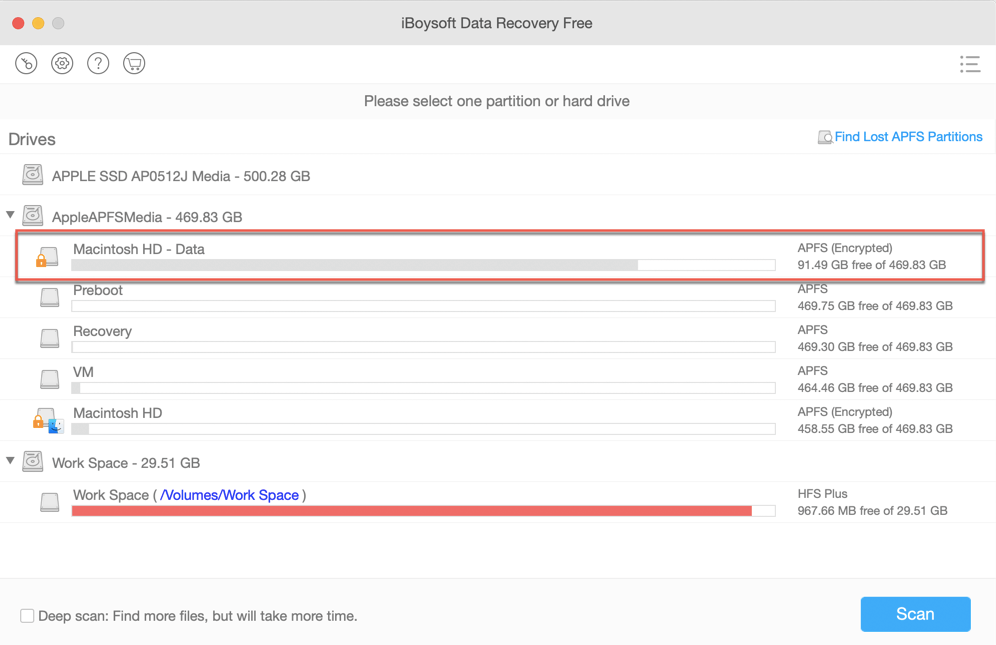
I bet most people don't know that the Mac operating system includes the experimental NTFS write support, but it is disabled by default. You can run some command lines in Terminal to enable it. However, Apple hasn't officially supported NTFS-writing ability yet. It is proven to be unstable and risky. It may cause disk corruption and permanent data loss. If you accidentally couldn't access your NTFS drives or lost data from them, try iBoysoft Data Recovery for Mac to recover important files.
This solution is not recommended, but if you are curious about how to enable Apple NTFS write support, follow the steps below:
Step 1: Go to the Applications > Utilities > Terminal to launch the Terminal program.
Step 2: Input 'sudo nano /etc/fstab' to edit the fstab file (provide your password when prompted). No letters will show up when you type in password.
Step 3: Type 'LABEL=VOLUME_NAME none ntfs rw,auto,nobrowse' in the editor window for the fstab file and press 'Control + O' to write. (Be sure to change the word VOLUME_NAME to the name of your NTFS volume)
Tips: If you have multiple NTFS drives you want to write to, write different line for each NTFS drive.
Step 4: Hit Enter and press 'Control + X' to exit.
Step 5: Re-connected the NTFS drive to the Mac.
Step 6: Click 'Go' at the top left menu bar and choose 'Go to Folder'.
Step 7: Type in /Volomes and hit Enter.
Step 8: Find the NTFS volume or drive and drag it to sidebar for easy access.
Tips: If you want to undo the change, follow the step 1 and step 2, then delete the command line. Save your change and exit.
Conclusion
Writing to NTFS drives on Mac is totally possible. You have several options to choose from - free NTFS drivers, cost-effective NTFS drivers and Apple's native NTFS support. Free NTFS drivers for Mac and Apple's NTFS support are free but take extra amount of work to mount NTFS drives on Mac in read-write mode. They are risky and very unstable. Even though iBoysoft NTFS for Mac is not completely free, it saves you a lot of time and effort for its excellent reliability and ease of use.
If you want to use external drives for file transferring between Windows and Mac frequently, it is a good idea to convert NTFS to exFAT or FAT32 to make the drives compatible with both platforms.